We pulled 423 cancer biology papers from PubMed, all original research articles published between January and December 2023. We excluded reviews, case reports, and editorials. Then we classified every title by structure, length, and keyword features, and checked citation counts as of April 2026, giving each paper 2–3 years to accumulate citations.
The question was simple: do certain title features predict higher citations? The answer is yes. The effect sizes are larger than we expected.
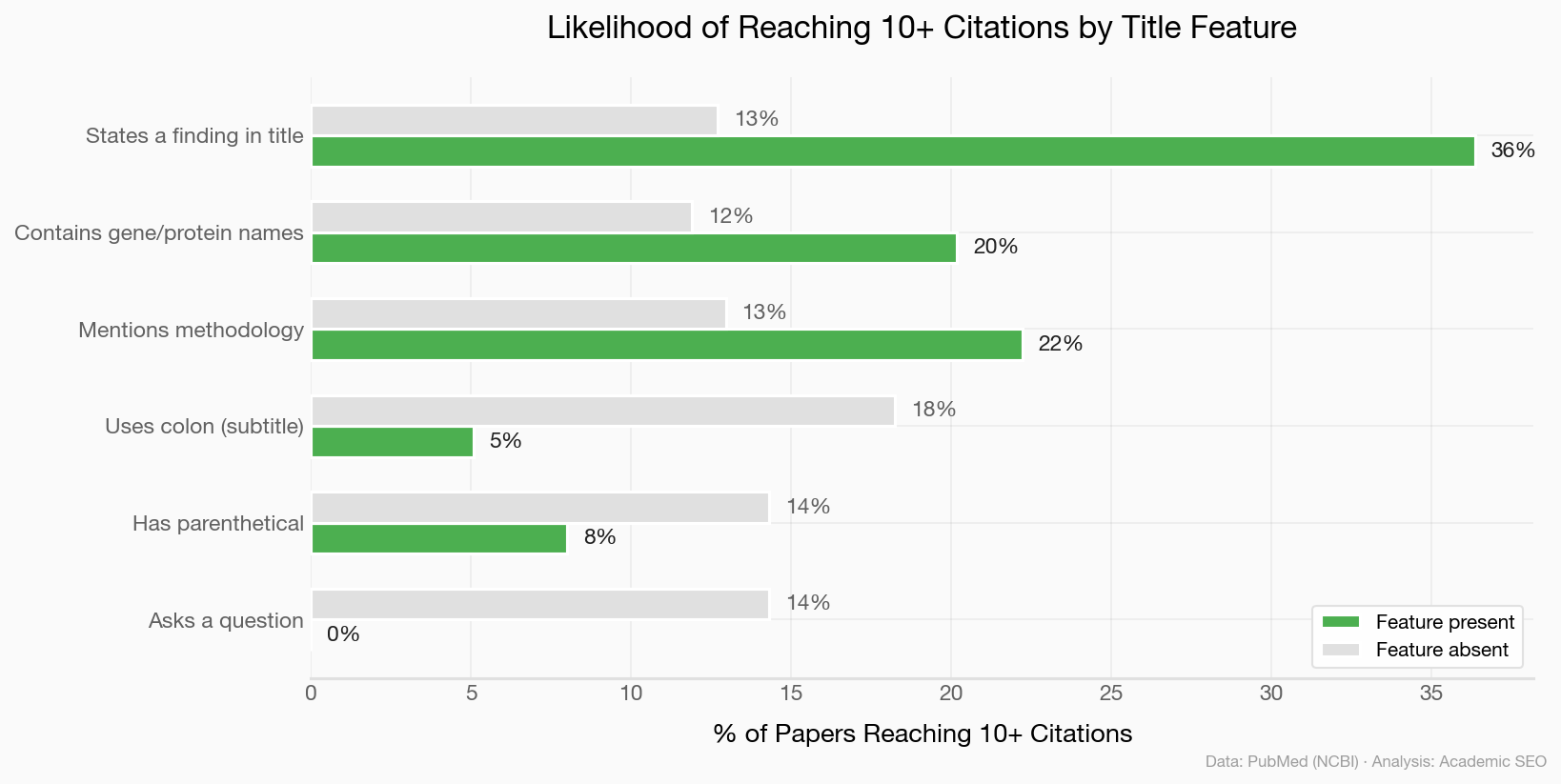
Declarative titles (those stating a finding) have 3.5x the median citations of descriptive titles. In our sample of 423 cancer biology papers, declarative titles had a median of 7 citations vs. 1 for descriptive titles. 36% of declarative titles reached 10+ citations, compared to only 13% of non-declarative titles.
What the Existing Literature Tells Us
Our analysis builds on a growing body of bibliometric research into how title characteristics affect citations. Several foundational studies set the stage for this work:
Letchford, Moat & Preis (2015) analysed 140,000 of the most-cited papers from the Scopus database (2007–2013) and found that journals publishing papers with shorter titles received more citations per paper (doi:10.1098/rsos.150266). Their work established the title-length–citation relationship at scale, though it operated at the journal level rather than the individual paper level.
Paiva, Lima & Paiva (2012) studied 423 articles from PLoS and BioMed Central journals and found that short titles describing results were independently associated with higher citation counts (doi:10.6061/clinics/2012(05)17). This is one of the few studies to examine both title length and title type (results-describing vs. non-results) simultaneously.
Jamali & Nikzad (2011) examined 2,172 articles from six PLoS journals and found that articles with question-mark titles were downloaded more but cited less than those with declarative or descriptive titles (doi:10.1007/s11192-011-0412-z). This distinction between download appeal and citation impact is important, a catchy title may attract clicks but not scholarly engagement.
Ball (2009) documented a 200% increase in question-mark titles across medicine, life sciences, and physics between 1966 and 2005, suggesting a marketing-driven shift in academic title conventions (doi:10.1007/s11192-007-1984-5).
Subotić & Mukherjee (2014) found that shorter titles correlated with more citations in psychology articles, though the effect was mediated by journal impact factor, raising the question of whether title characteristics are causes or correlates of citation success (doi:10.1177/0165551513511393).
What the existing literature lacks is field-specific, recent data from biomedical subfields. Most studies use cross-disciplinary samples, older publication windows, or relatively small sample sizes. Our analysis focuses specifically on cancer biology papers from 2023, examining title structure types (declarative, descriptive, compound, question) alongside length and keyword features, adding a dimension that previous work on title length alone does not capture.
Methodology: How We Collected and Analysed the Data
Transparency matters, so here is exactly what we did:
- Sample selection: We searched PubMed for cancer biology original research articles published January–December 2023. We excluded reviews, case reports, editorials, letters, and commentaries. This yielded 423 papers.
- Title classification: Each title was manually classified into one of four structural types: declarative (states a finding, e.g., "X promotes Y via Z pathway"), descriptive (describes the topic, e.g., "A study of X in Y"), compound (uses a colon to separate main title and subtitle), or question (poses a research question).
- Feature coding: We coded each title for word count, presence of gene/protein names, mention of methodology, and use of colons.
- Citation counts: Retrieved via PubMed's cited-by links as of April 2026. PubMed citation counts undercount true citations (they miss citations from non-indexed journals and preprints), but they are consistent and reproducible.
423 cancer biology papers | Published Jan–Dec 2023 | Original research only
Citation range: 0–124 | Mean: 6.3 | Median: 2
Zero citations: 125 papers (29.6%)
Data source: PubMed (NCBI), 423 cancer biology papers published January–December 2023. Citation counts retrieved April 2026.
Finding 1: Title Structure Matters Most
Of everything we measured, the structural type of the title had the largest association with citation count. We classified all 423 titles into four types:
- Declarative titles (n=22): Median 7 citations, mean 16.7. These titles state a finding directly, "GPR143 controls ESCRT-dependent exosome biogenesis and promotes cancer metastasis" (81 citations).
- Descriptive titles (n=259): Median 1 citation, mean 7.3. These describe the topic without stating the result, "Multiomics in primary and metastatic breast tumors from the AURORA US network" (97 citations, but this is an outlier).
- Compound titles (n=131): Median 2 citations, mean 3.0. These use a colon to separate the topic from a subtitle.
- Question titles (n=11): Median 1 citation, mean 1.2. These performed worst of any structure type.
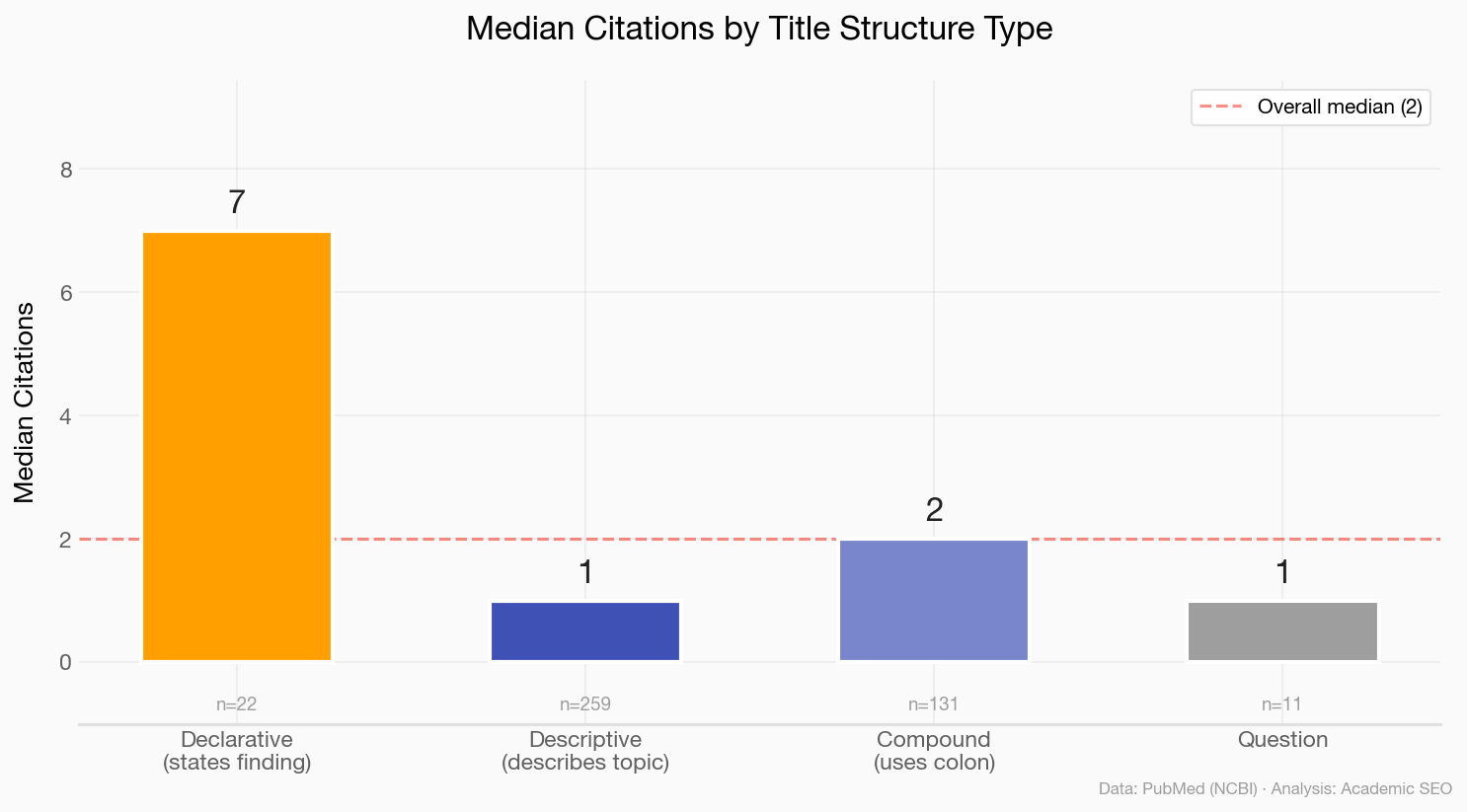
The difference is stark. Declarative titles had a median of 7 citations; every other type had a median of 1 or 2. And 36% of declarative titles reached 10+ citations, compared to only 13% of non-declarative titles.
A declarative title answers the question "What did you find?" before the reader opens the paper. In a world where researchers skim hundreds of titles per week, this is a massive advantage. It signals confidence, specificity, and relevance.
This does not mean you should force a declarative title onto every paper. Some journals discourage them. And correlation is not causation, stronger findings may naturally produce both declarative titles and more citations. But the signal is strong enough to take seriously.
Finding 2: The Sweet Spot Is 9–14 Words
Title length had a clear association with citation count. We grouped titles into four length buckets:
- Short titles (8 words or fewer): Mean 6.2 citations
- Medium titles (9–14 words): Mean 8.6 citations, the highest of any group
- Long titles (15–20 words): Mean 4.5 citations
- Very long titles (21+ words): Mean 4.0 citations
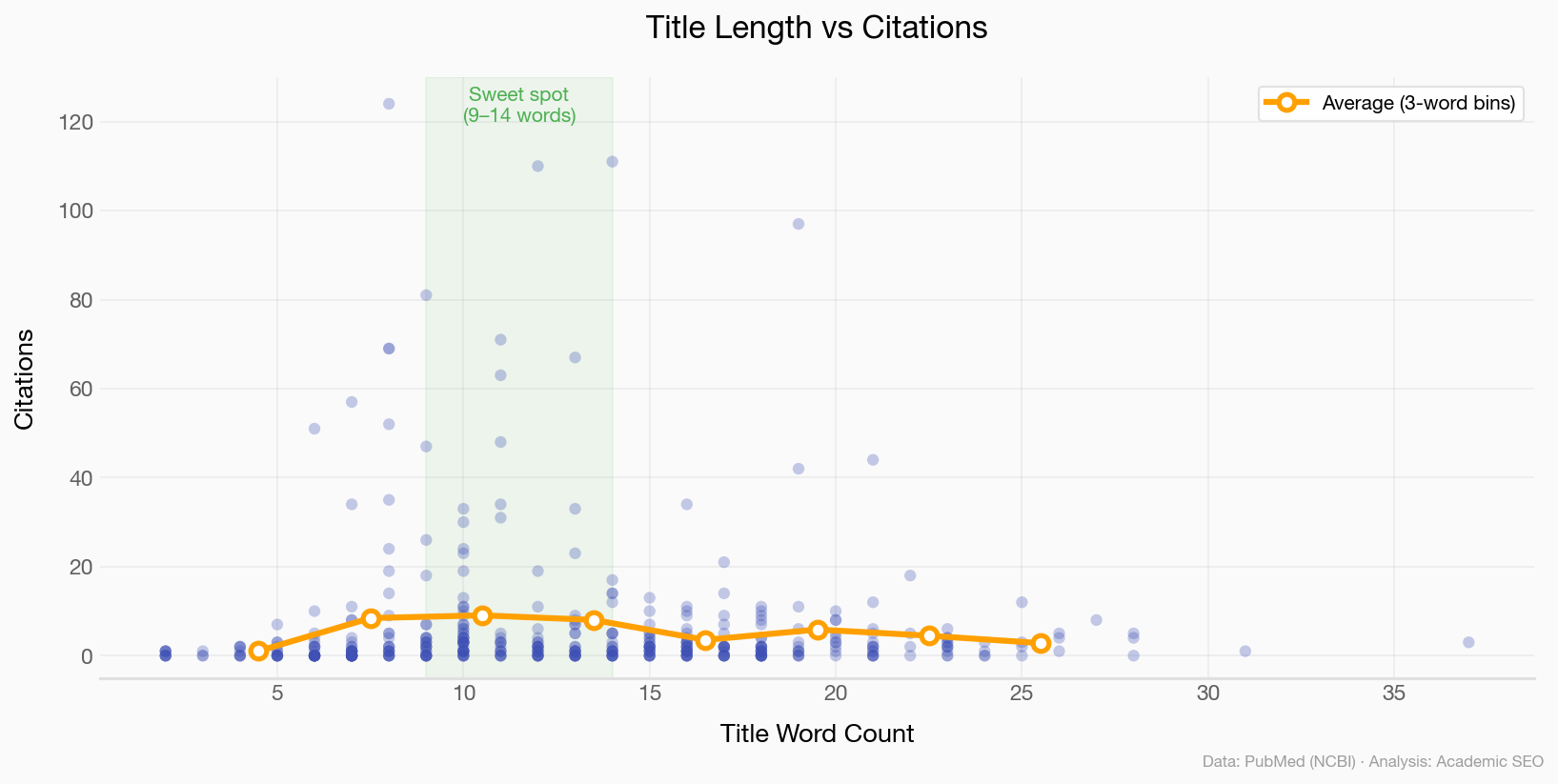
The 9–14 word sweet spot aligns with broader bibliometric research (Letchford et al. 2015 found 10–12 words optimal across 140,000 papers). Titles below 8 words tend to lack specificity. Titles above 20 words become verbose and harder to scan.
Look at the top-cited papers in our sample. The second-highest (110 citations) was 12 words: "Y chromosome loss in cancer drives growth by evasion of adaptive immunity." The fourth-highest (81 citations) was 9 words: "GPR143 controls ESCRT-dependent exosome biogenesis and promotes cancer metastasis." Both hit the sweet spot.
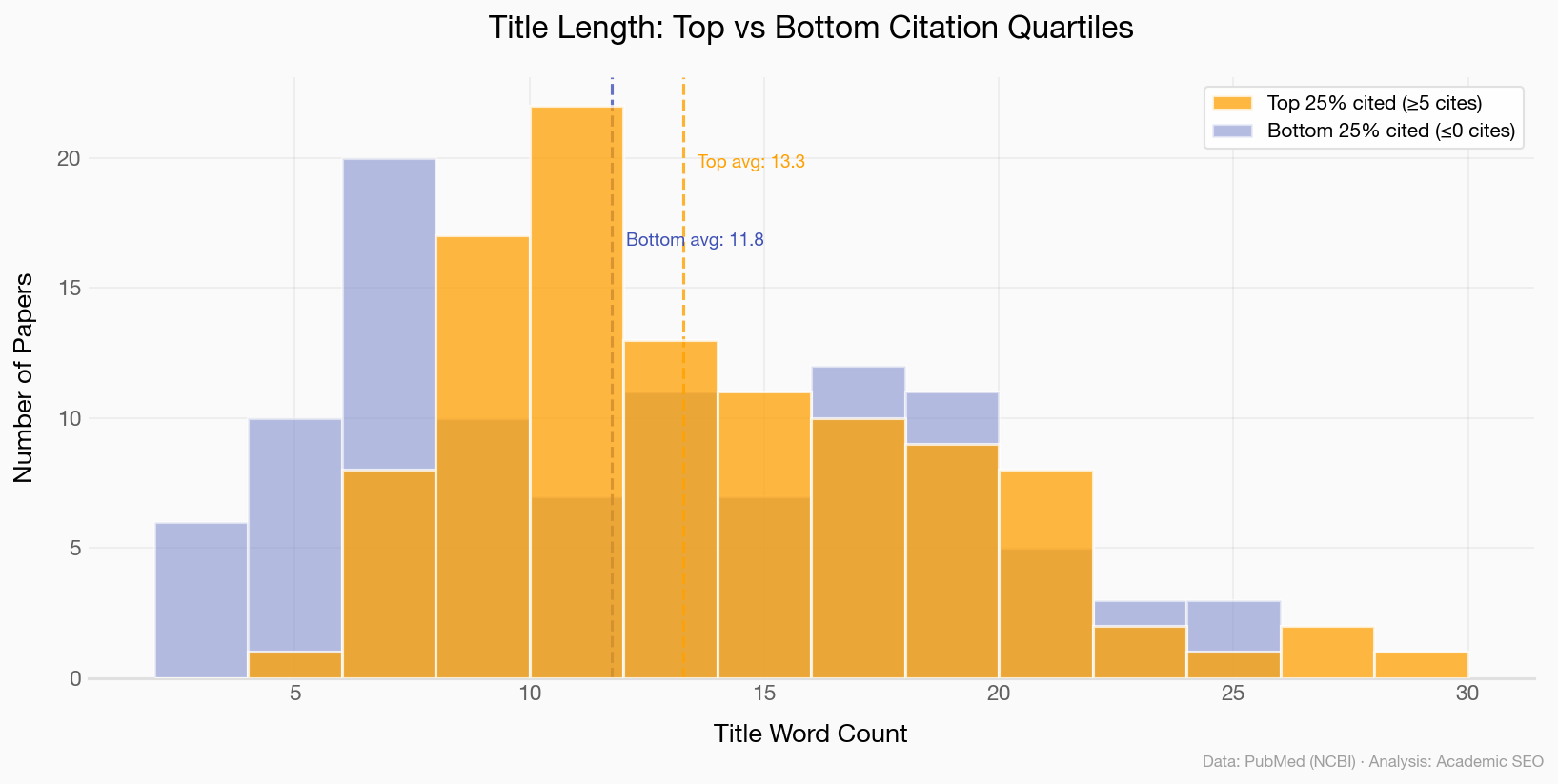
Finding 3: Features That Help and Hurt
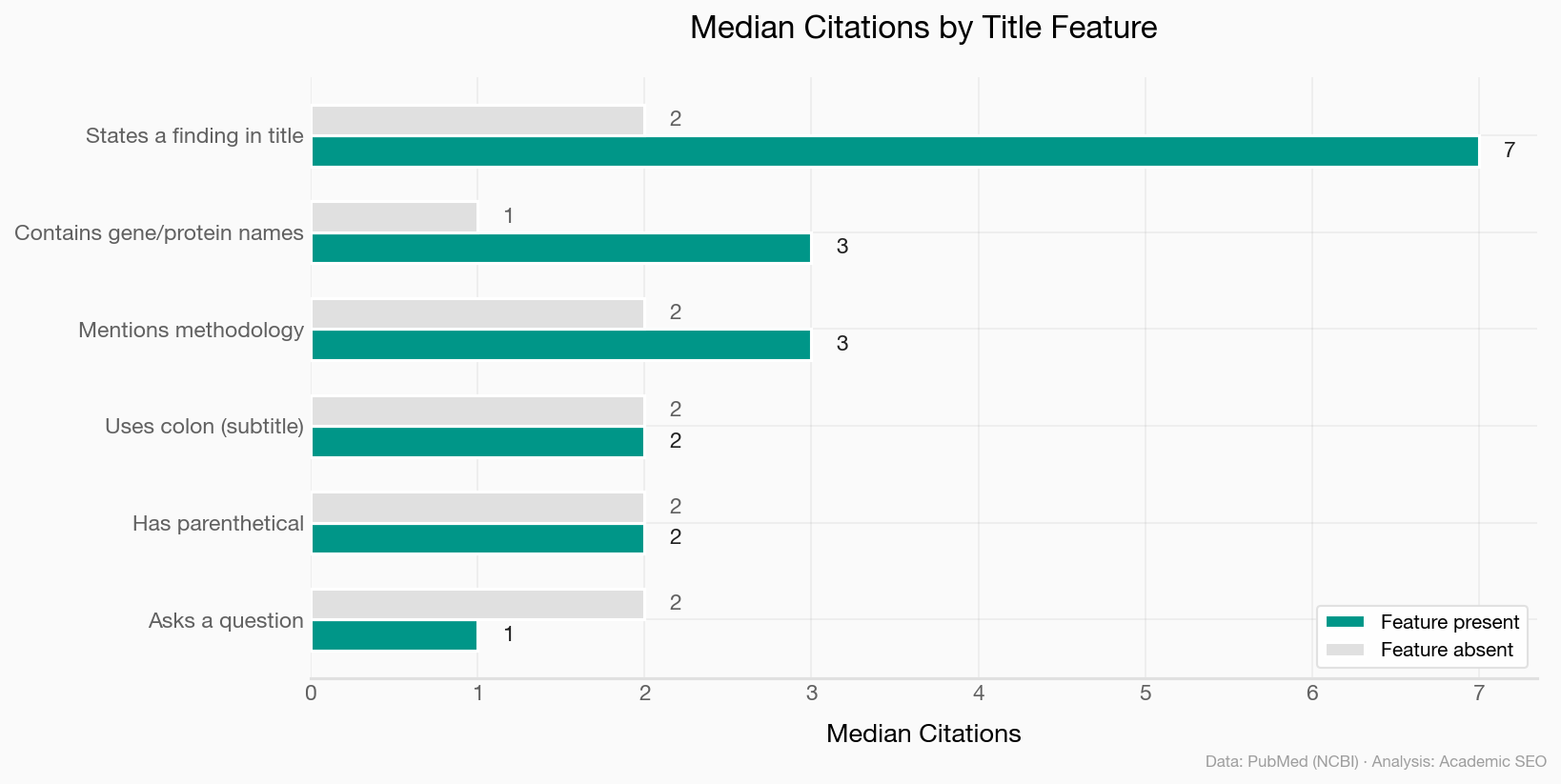
Beyond structure and length, we coded several binary features and compared citation outcomes.
Gene or protein names in the title: helpful
Papers with gene or protein names in the title (n=104) had a median of 3 citations, compared to 1 for papers without (n=319). Gene names serve as precise, searchable keywords. If someone is searching for "GPR143" or "BRCA1," a title containing that term will rank higher and attract a more targeted readership.
Methodology keywords: slight help
Papers mentioning methodology in the title (n=45) had a median of 3 citations vs. 2 for papers without (n=378). Terms like "single-cell RNA-seq," "CRISPR screen," or "meta-analysis" help readers quickly assess whether the paper's methods are relevant to their own work.
Colon (subtitle structure): hurts
Titles with colons averaged 3.0 citations; titles without colons averaged 7.9 citations. This is one of the largest effects we observed. Compound titles often split the reader's attention and tend to be longer, which may partly explain the penalty.
Finding 4: The Citation Distribution Is Brutal
Before discussing strategy, it is worth confronting the baseline reality.
Of 423 cancer biology papers published in 2023, 125 (29.6%) had zero citations as of April 2026. Nearly a third of published original research attracted no recorded citations in 2–3 years. The full distribution:
- 0 citations: 125 papers (29.6%)
- 1–5 citations: 209 papers (49.4%)
- 6–20 citations: 58 papers (13.7%)
- 21–50 citations: 18 papers (4.3%)
- 50+ citations: 13 papers (3.1%)
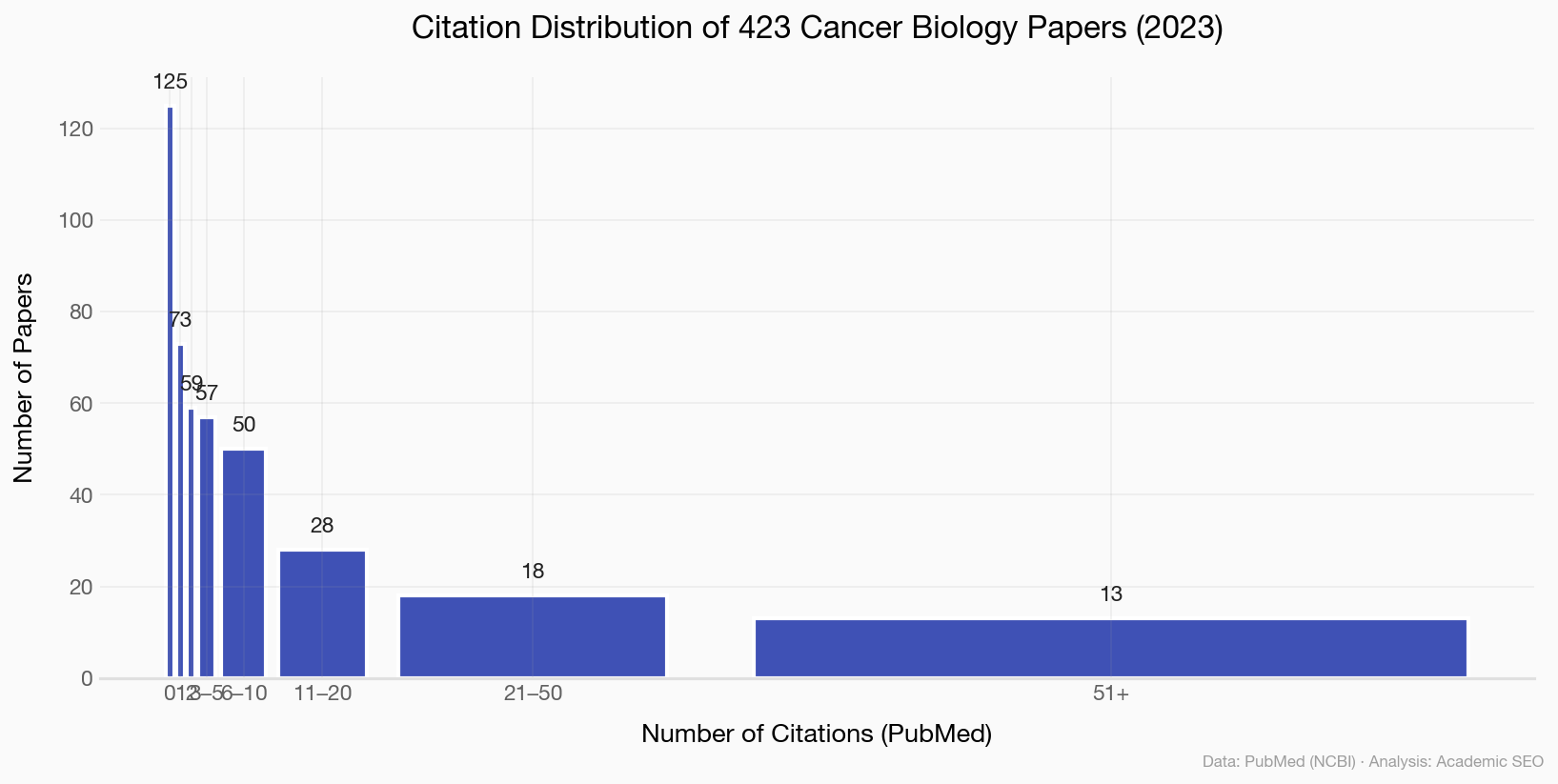
The mean of 6.3 is misleading, it is pulled up by a handful of highly cited papers (the top paper had 124 citations). The median of 2 is a more honest measure of what a typical cancer biology paper accumulates in 2–3 years.
This context matters for interpreting the findings above. Moving from a median of 1 (descriptive title) to a median of 7 (declarative title) is the difference between near-invisibility and meaningful engagement.
What This Means for Your Next Paper
Based on the data, here is what we would recommend when writing a cancer biology paper title (and the principles likely generalise to other biomedical fields):
- State your finding in the title whenever possible. "X promotes Y via Z" outperforms "A study of X in Y" by a wide margin. If your journal allows declarative titles, use them.
- Target 9–14 words. This is the sweet spot in our data and in broader bibliometric literature. Shorter titles lack specificity; longer titles lose readers.
- Include gene or protein names if your paper focuses on specific molecular targets. These function as precise search keywords.
- Avoid unnecessary colons. If you can express your title as a single direct statement, do so. Compound titles are associated with lower citations in our data.
- Avoid question titles. They performed worst of any structure type (mean 1.2 citations). Questions signal uncertainty; declarative titles signal confidence.
- Mention methodology only when it's a genuine differentiator. "Single-cell RNA-seq" or "CRISPR screen" in the title can help if the method is a key selling point.
A model title from our dataset
Consider the fourth-most-cited paper in our sample (81 citations):
"GPR143 controls ESCRT-dependent exosome biogenesis and promotes cancer metastasis."
This title is 9 words, declarative (states the finding), includes a gene name (GPR143), and uses no colon. It hits every marker associated with higher citations in our analysis.
Limitations
We are reporting correlations, not causal relationships. It is important to be transparent about the limitations:
- Correlation, not causation. Papers with declarative titles may have stronger findings, which independently attract more citations. The title structure may be a symptom of research quality, not a cause of citation success. We cannot disentangle these effects with observational data alone.
- Sample size. 423 papers is a reasonable sample for exploratory analysis, but some subgroups are small (e.g., n=22 for declarative titles, n=11 for question titles). These findings need replication with larger samples.
- Field-specific. These data are from cancer biology. Title conventions and citation patterns differ across fields. The specific numbers may not generalise to physics, social sciences, or humanities.
- PubMed citation counts undercount. PubMed only tracks citations from PubMed-indexed journals. Citations from preprints, books, non-indexed journals, and grey literature are missed. Actual citation counts may be higher across the board.
- Confounding variables. We did not control for journal prestige, author reputation, funding, open-access status, or research topic (within cancer biology). Any of these could confound the title-citation relationship.
- Survivorship bias in top examples. The highest-cited papers we highlight as examples may be influential for reasons beyond their titles (e.g., novel findings, high-profile authors, media coverage).
Despite these limitations, the effect sizes are large and the direction is consistent across multiple features. The practical recommendation, use declarative, mid-length titles with specific keywords, carries low risk and aligns with broader bibliometric evidence.
References
- Letchford A, Moat HS, Preis T. The advantage of short paper titles. R Soc Open Sci. 2015;2(8):150266. doi:10.1098/rsos.150266
- Paiva CE, Lima JPSN, Paiva BSR. Articles with short titles describing the results are cited more often. Clinics. 2012;67(5):509–513. doi:10.6061/clinics/2012(05)17
- Jamali HR, Nikzad M. Article title type and its relation with the number of downloads and citations. Scientometrics. 2011;88:653–661. doi:10.1007/s11192-011-0412-z
- Ball R. Scholarly communication in transition: The use of question marks in the titles of scientific articles in medicine, life sciences and physics 1966–2005. Scientometrics. 2009;79(3):667–679. doi:10.1007/s11192-007-1984-5
- Subotić S, Mukherjee B. Short and amusing: The relationship between title characteristics, downloads, and citations in psychology articles. J Inf Sci. 2014;40(1):115–124. doi:10.1177/0165551513511393
- Falagas ME, Zarkali A, Karageorgopoulos DE, Bardakas V, Mavros MN. The impact of article length on the number of future citations: A bibliometric analysis of general medicine journals. PLoS ONE. 2013;8(2):e49476. doi:10.1371/journal.pone.0049476
Frequently Asked Questions
Do declarative titles actually get more citations in cancer biology?
In our sample of 423 cancer biology papers from PubMed (2023), declarative titles had a median of 7 citations compared to 1 for descriptive titles and 1 for question titles. 36% of declarative titles reached 10+ citations vs only 13% of non-declarative titles. This is a correlation, not proof of causation, but the effect size is large.
What is the best title length for a cancer biology paper?
In our analysis, titles of 9–14 words had the highest mean citations (8.6), compared to 6.2 for short titles (8 words or fewer), 4.5 for long titles (15–20 words), and 4.0 for very long titles (21+ words). This aligns with broader bibliometric research suggesting 10–12 words is optimal.
Should I use a colon (subtitle) in my paper title?
In our dataset, titles with colons averaged 3.0 citations vs 7.9 for titles without colons. This does not mean colons cause lower citations, compound titles may be more common in descriptive or methods-focused papers. But it suggests that if you can state your finding directly without a subtitle, you should.
Does including gene or protein names in the title help citations?
Yes, in our sample. Papers with gene or protein names in the title had a median of 3 citations (n=104) vs 1 citation for papers without (n=319). Gene names likely serve as precise search terms that help the right readers find the paper.
How many cancer biology papers get zero citations?
In our sample of 423 papers published in 2023 (with 2–3 years for citations to accumulate), 125 papers (29.6%) had zero citations as of April 2026. This is consistent with broader bibliometric data showing that roughly a third of published papers are never cited.
Ready to optimise your paper before you publish?
We optimise your title, abstract, keywords, readability, and metadata for Google Scholar, PubMed, and AI search engines.
Submit your paper →